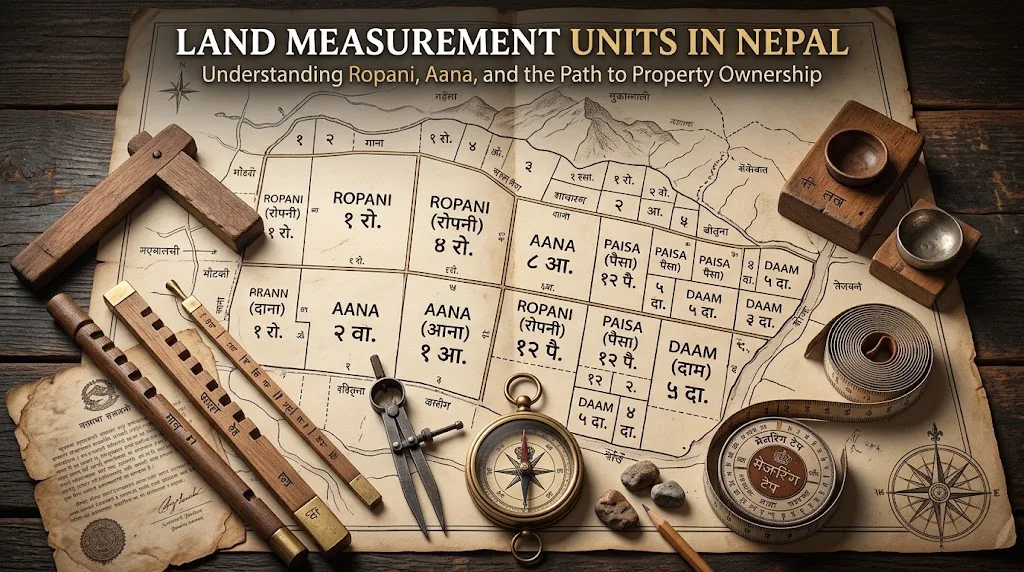
Buying Property in Nepal as an NRN: Legal Requirements, Process, and Rules
For Non-Resident Nepalis (NRNs) living across the globe, purchasing real estate back home in Nepal holds both emotional and financial significance. Whether you are planning a retirement home, securing ancestral roots, or investing in residential real estate, Nepali law grants Foreign Citizens of Nepali Origin specific rights to acquire and hold property.
However, purchasing property as an NRN follows a distinct legal workflow governed by the Non-Resident Nepali Act, 2064 and NRN Rules, 2066. Here is a comprehensive guide to understanding land ceilings, legal requirements, and step-by-step procedures.
1. Statutory Land Ownership Limits for NRNs
Under Rule 11 of the NRN Rules, 2066, an NRN cardholder is allowed to purchase land for residential purposes for themselves or their immediate family. The law imposes strict geographical ceilings on property area:
| Location / Region | Maximum Land Ceiling Allowed |
|---|---|
| Kathmandu Valley | Up to 2 Ropani |
| Terai Municipalities | Up to 8 Kattha |
| Other Municipalities | Up to 4 Ropani |
| Terai Rural Areas (VDCs) | Up to 1 Bigha |
| Other Rural Areas | Up to 10 Ropani |
Note: These area ceilings apply to residential land acquired under NRN status. Different conditions apply to property inherited or acquired prior to giving up Nepali citizenship.
2. Mandatory Eligibility Prerequisites
To purchase property under the NRN quota, buyers must fulfill three core criteria:
- Valid NRN Identity Card: You must possess an active NRN ID card issued by the Ministry of Foreign Affairs (MoFA) or Nepalese Diplomatic Missions abroad.
- Residential Purpose Declaration: The property must be designated for personal residential use, not for agricultural or industrial use (unless registered under separate FDI rules).
- No-Existing-Property Declaration: Buyers must submit a formal declaration stating that neither they nor their dependent family members currently own residential property under NRN provisions in Nepal.
3. Step-by-Step Purchase Process
Unlike standard transactions between Nepali citizens, NRN property purchases require formal government authorization before final title transfer at the Land Revenue Office (Malpot Karyalaya).
[1. Select Property & Due Diligence]
            │
            ▼
[2. Apply to Ministry of Foreign Affairs (MoFA)]
            │
            ▼
[3. Receive Government Approval Letter]
            │
            ▼
[4. Transfer Funds via Official Banking Channels]
            │
            ▼
[5. Final Deed Execution at Land Revenue Office (Malpot)]
Step 1: Property Selection & Due Diligence
Select your desired home or land parcel and conduct physical and legal title checks:
- Verify Lalpurja (Land Certificate), Kitta No. (Plot Number), and Napi (Survey) boundary maps.
- Ensure the property falls strictly within permitted geographical limits (e.g., maximum 2 Ropani in Kathmandu).
Step 2: Apply for Government Approval
Submit a formal application to the Secretary of the Ministry of Foreign Affairs (MoFA) requesting permission to purchase the specified parcel.
Required Documents:
- Copy of valid NRN Card.
- Copy of Passport and Foreign Citizenship Certificate.
- Copy of Seller's Lalpurja and Citizenship Certificate.
- Official Land Survey Map (Napi Naksa) and Trace Map of the plot.
- Written Declaration of no prior residential property ownership in Nepal under NRN quota.
- Preliminary sale/purchase agreement specifying total valuation.
Step 3: Formal Ministry Authorization
Upon evaluating your documentation and confirming compliance with land ceilings, MoFA issues an official Approval Letter authorizing the purchase of the specific parcel.
Step 4: Transfer Funds via Formal Banking Channels
Transfer the purchase funds through official banking channels (Nepal Rastra Bank approved foreign exchange routing). Retain all swift advices and bank vouchers as proof of foreign currency remittance.
Step 5: Final Transfer at Malpot Karyalaya
Present the MoFA Approval Letter, bank vouchers, legal deed (Rajinama), and identification documents before the concerned Land Revenue Office (Malpot). Upon registration and payment of applicable transfer taxes, the official ownership certificate (Lalpurja) will be issued under your name.
4. Key Financial Considerations & Limitations
- Repatriation Limits: Capital gains and proceeds from selling property purchased under NRN residential provisions cannot automatically be repatriated in foreign currency without specific approvals. Funds generally remain within Nepal's domestic financial ecosystem.
- Inheritance Exemptions: NRNs retain rights to inherit ancestral property from legal heirs under the National Civil Code, which operates under distinct provisions from direct purchases.
Conclusion
Buying property in Nepal as an NRN is a streamlined process once you understand the land ceilings and secure MoFA approval prior to purchase. Always consult local real estate legal advisors to review title deeds and boundary maps before transferring advance payments.