Commercial Real Estate vs. Residential Plots: Which Yields Better Rental Returns in Nepal?
When investing in Nepali real estate, investors generally target two goals: Capital Appreciation (increase in property value over time) and Rental Yield (regular annual cash flow from tenants).
While residential land plots have historically been Nepal's preferred choice for capital gains, commercial properties—such as office spaces, retail shutters, and multi-story complexes—are gaining traction among income-focused investors.
This guide breaks down how rental yields compare across commercial and residential sectors in Nepal.
Understanding Rental Yield
Rental yield measures the annual rental income generated by a property relative to its total purchase/market value:
$$\text{Gross Rental Yield (%)} = \left( \frac{\text{Annual Gross Rental Income}}{\text{Total Property Purchase Price}} \right) \times 100$$
Example: If a house worth NPR 3,000,000 (3 Crore) generates NPR 100,000 per month in rent (NPR 1,200,000 annually):
$$\text{Rental Yield} = \left( \frac{1,200,000}{30,000,000} \right) \times 100 = 4.0%$$
1. Residential Real Estate Returns
Residential property investments in Nepal primarily include single-family houses, apartment units, and floor rentals to local families or expats.
Key Metrics:
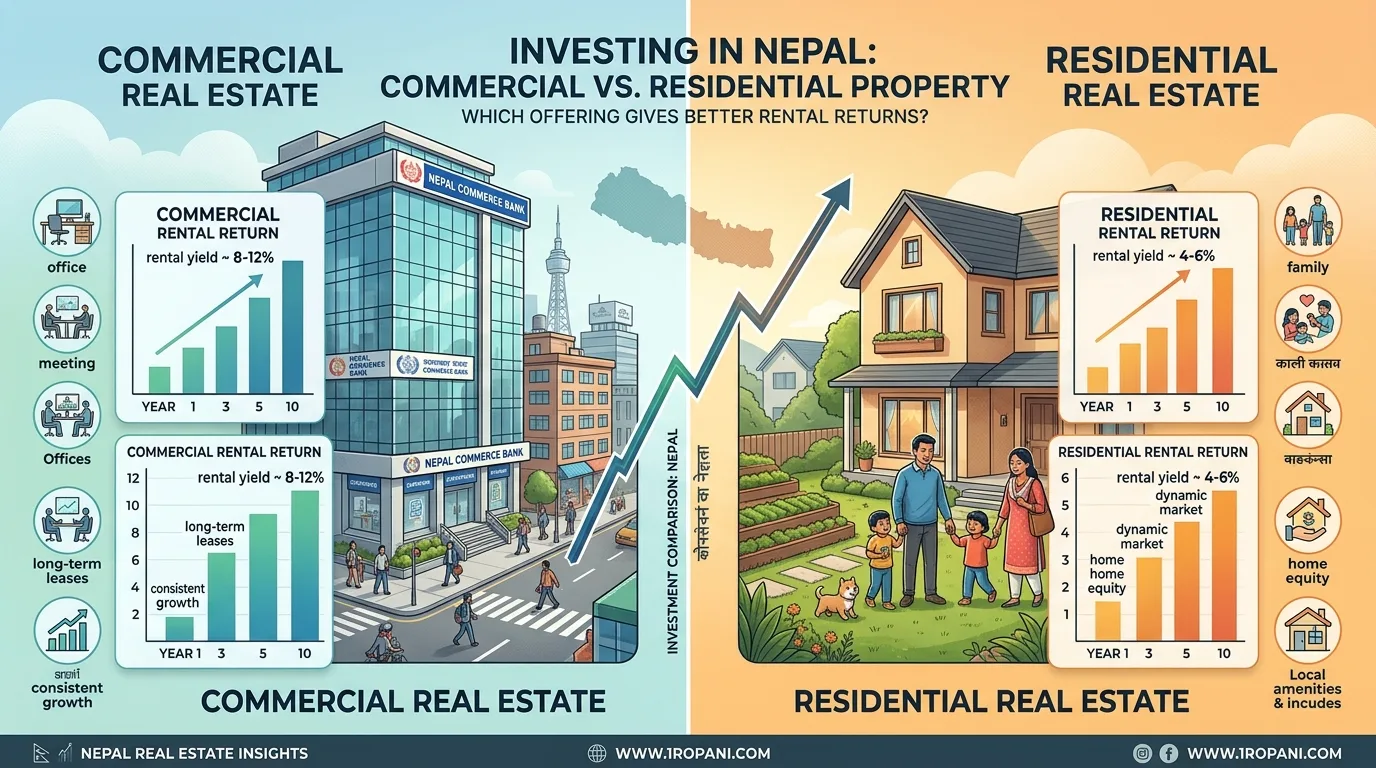
- Typical Rental Yield: 2.5% to 4.5% annually in Kathmandu Valley.
- Tenant Stability: High demand for quality living space, but frequent tenant turnover in suburban rental flats.
- Lease Agreements: Typically 1-year renewable agreements with standard 5% to 10% rent escalation clauses every 2 years.
Advantages:
- Lower vacancy risks in high-density areas (near colleges, hospitals, and business centers).
- Easier to sell or liquidate residential land plots during market upturns.
2. Commercial Real Estate Returns
Commercial properties include retail ground-floor spaces (Shutters), office complexes, bank branches, and commercial land along main arterial roads (e.g., New Baneshwor, Durbar Marg, Lazimpat, Prithvi Highway corridors).
Key Metrics:
- Typical Rental Yield: 5.5% to 9.0% annually.
- Lease Terms: Long-term leases ranging from 3 to 10 years, often signed by corporate entities, banks, or franchise chains.
- Maintenance Structure: Commercial tenants often bear interior fitting and routine maintenance costs under Triple Net (NNN) or customized commercial lease contracts.
Advantages:
- Significantly higher monthly cash flow compared to residential units.
- Long-term rental predictability with corporate lock-in periods.
3. Financial Comparison Matrix
| Factor | Residential Property | Commercial Property |
|---|---|---|
| Average Gross Rental Yield | 2.5% – 4.5% | 5.5% – 9.0% |
| Capital Appreciation Rate | High (Driven by land scarcity) | Moderate to High (Driven by location) |
| Initial Investment Needed | Moderate | High |
| Tenant Lease Duration | 1 – 2 Years | 3 – 10 Years |
| Vacancy Impact | Low to Moderate | High (Finding corporate tenants takes time) |
4. How to Maximize Returns in Nepal
- Target Mixed-Use Properties: Buildings featuring ground-floor commercial shutter spaces combined with residential apartments upstairs balance high commercial yields with reliable residential occupancy.
- Focus on Transportation Corridors: Properties situated along newly expanded highway stretches or fast-track bypass routes experience rapid transition from residential to high-yield commercial zoning.
- Verify Parking Regulations: Commercial tenants in urban Nepal require adequate basement or ground parking for cars and two-wheelers. Buildings with dedicated parking command up to 30% higher rental rates.
Final Verdict
- Choose Residential Land/Housing if your primary goal is long-term capital appreciation with low operational stress.
- Choose Commercial Real Estate if your goal is immediate, high annual cash flow and long-term corporate lease stability.